MAC Address in Computer Network
In order to communicate or transfer the data from one computer to another computer we need some address. In Computer Network various types of address are introduced; each works at different layer. Media Access Control Address is a physical address which works at Data Link Layer. In this article, we will discuss about addressing in DLL, which is MAC Address.
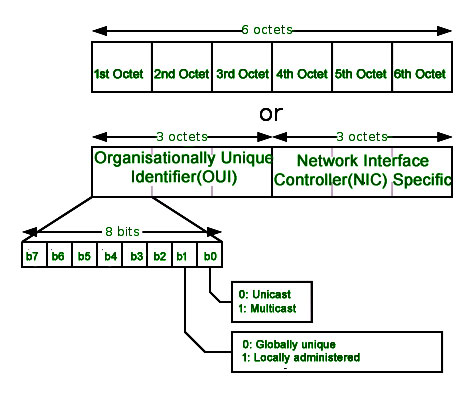
Here are some OUI of well known manufacturers :
As discussed above, MAC address is represented by Colon-Hexadecimal notation. But this is just a conversion, not mandatory. MAC address can be represented using any of the following formats –
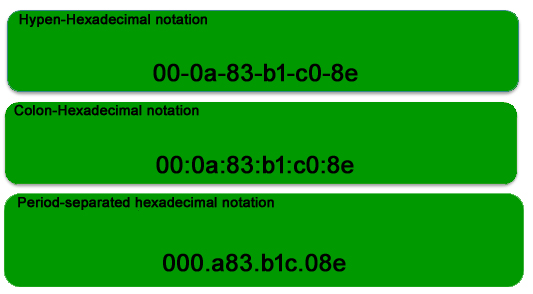
Note: Colon-Hexadecimal notation is used by Linux OS and Period-separated Hexadecimal notation is used by Cisco Systems.
Media Access Control (MAC) Address –
MAC Addresses are unique 48-bits hardware number of a computer, which is embedded into network card (known as Network Interface Card) during the time of manufacturing. MAC Address is also known as Physical Address of a network device. In IEEE 802 standard, Data Link Layer is divided into two sublayers –- Logical Link Control(LLC) Sublayer
- Media Access Control(MAC) Sublayer
Format of MAC Address –
MAC Address is a 12-digit hexadecimal number (6-Byte binary number), which is mostly represented by Colon-Hexadecimal notation. First 6-digits (say 00:40:96) of MAC Address identifies the manufacturer, called as OUI (Organizational Unique Identifier). IEEE Registration Authority Committee assign these MAC prefixes to its registered vendors.Here are some OUI of well known manufacturers :
CC:46:D6 - Cisco
3C:5A:B4 - Google, Inc.
3C:D9:2B - Hewlett Packard
00:9A:CD - HUAWEI TECHNOLOGIES CO.,LTD
The rightmost six digits represents Network Interface Controller, which is assigned by manufacturer.
As discussed above, MAC address is represented by Colon-Hexadecimal notation. But this is just a conversion, not mandatory. MAC address can be represented using any of the following formats –
Note: Colon-Hexadecimal notation is used by Linux OS and Period-separated Hexadecimal notation is used by Cisco Systems.
How to find MAC address –
Command for UNIX/Linux -  ifconfig -a
                          ip link list
                          ip address show

Command forWindows OS -   ipconfig /all

MacOS -                   TCP/IP Control Panel
Note – LAN technologies like Token Ring, Ethernet use MAC Address as their Physical address but there are some networks (AppleTalk) which does not use MAC address.
Comments
Post a Comment