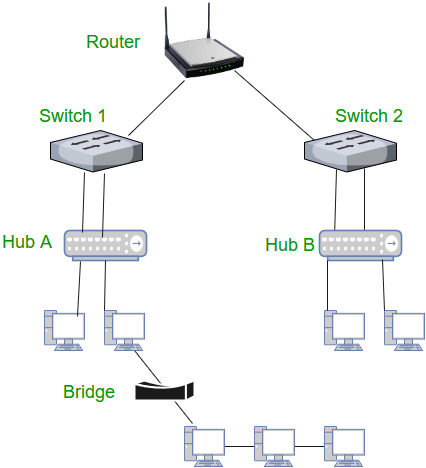
Bridge – A bridge
operates at data link layer. A bridge is a repeater, with add on the
functionality of filtering content by reading the MAC addresses of
source and destination. It is also used for interconnecting two LANs
working on the same protocol. It has a single input and single output
port, thus making it a 2 port device.
Types of Bridges
Routers – A router is a device like a switch that routes data packets based on their IP addresses. Router is mainly a Network Layer device. Routers normally connect LANs and WANs together and have a dynamically updating routing table based on which they make decisions on routing the data packets. Router divide broadcast domains of hosts connected through it.
Types of Bridges
- Transparent Bridges:- These are the bridge in which the stations are completely unaware of the
bridge’s existence i.e. whether or not a bridge is added or deleted from the network, reconfiguration of
the stations is unnecessary. These bridges make use of two processes i.e. bridge forwarding and bridge learning. - Source Routing Bridges:- In these bridges, routing operation is performed by source station and the frame specifies which route to follow. The hot can discover frame by sending a special frame called discovery frame, which spreads through the entire network using all possible paths to destination.
Routers – A router is a device like a switch that routes data packets based on their IP addresses. Router is mainly a Network Layer device. Routers normally connect LANs and WANs together and have a dynamically updating routing table based on which they make decisions on routing the data packets. Router divide broadcast domains of hosts connected through it.
6. Gateway – A gateway,
as the name suggests, is a passage to connect two networks together that
may work upon different networking models. They basically work as the
messenger agents that take data from one system, interpret it, and
transfer it to another system. Gateways are also called protocol
converters and can operate at any network layer. Gateways are generally
more complex than switch or router.

Comments
Post a Comment